You’re holding an important document—maybe a contract, a certificate, or immigration papers—and you need it translated accurately. But finding the right person to handle it feels overwhelming. Should you trust online tools? How do you know if a translator understands legal terminology? Will authorities actually accept the translation?
If you’re searching for legal translation services near me in Dubai, you’re not alone. Many individuals and businesses face this challenge every day. The difference between a quick translation and a reliable one can have real consequences—especially when official documents are involved. This guide walks you through everything you need to know to find trustworthy translation services in your area and make the right choice for your situation.
What Is a Legal Translation Service, and When Do You Need One?
A legal translation service goes beyond converting words from one language to another. It requires an understanding of legal terminology, local regulations, and the specific requirements of official institutions.
The Difference Between Standard and Legal Translation
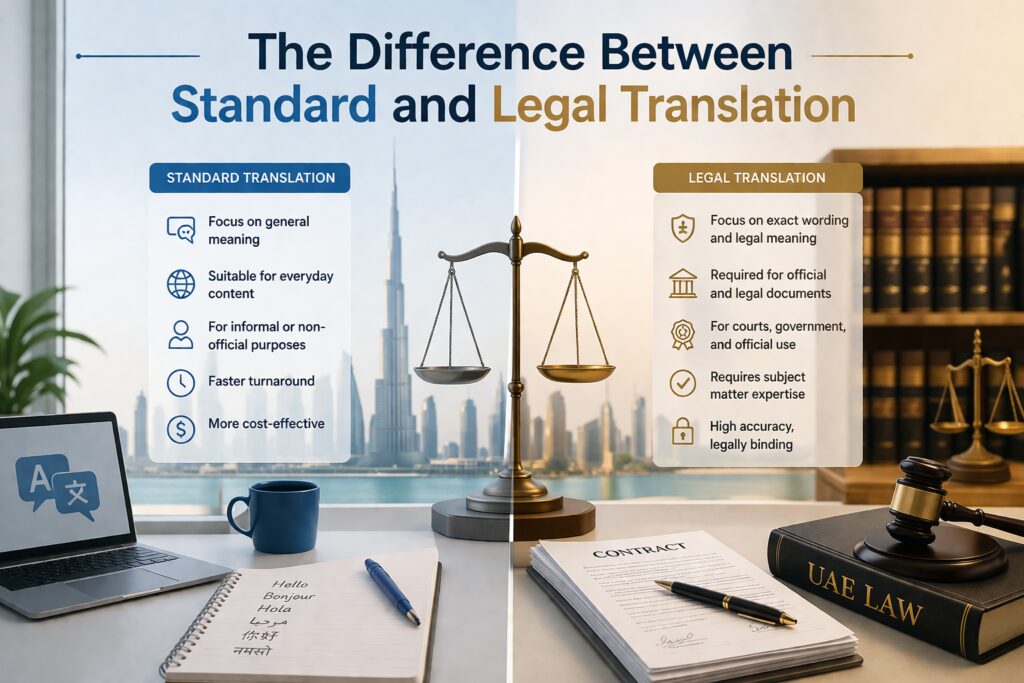
Translation is not equally created — While a generic translator would be able to get the gist of something for most documents, a legal translation service needs an exact limit and precise knowledge about how various legal systems function.
Legal translations cover documents like:
- Employment contracts and agreements
- Marriage or divorce certificates
- Power of attorney documents
- Property deeds and ownership papers
- Court documents and legal correspondence
- Immigration and visa-related paperwork
- Insurance policies and claims
- Business licenses and corporate documents
When it comes to documents meant for submission to a government office, court, or other official institution, precision is not optional.
Common Situations Where You’ll Need Legal Translation
Personal situations: Moving to the UAE for work often means translating your educational certificates, birth certificates, or marriage documents. Immigration offices require official translations, not casual conversions.
Business scenarios: Companies expanding into the UAE frequently need contracts translated. A single misinterpreted clause can create legal or financial problems down the road.
Legal matters: If you’re involved in a dispute or court proceeding, every word matters. The translation must preserve the exact meaning and legal intent of the original document.
Financial transactions: Banks and lending institutions require certified translations for applications, especially when documents originate from non-English-speaking countries.
Why Choosing a Local Provider Matters
But you may ask — what about an online translator, or validating someone over a remote outsourced role? This is where a local legal translation service near me in Dubai truly comes into play.
Local Knowledge and Compliance
Different systems of law in various countries. It is necessary to browse the net and see which agencies give qualified translations that suit your requirements, for example, a UAE-based translator knows exactly how you can get a certified translation in Dubai for court and institution submission. They stay informed about what format is accepted by authorities, which certifications are required, and how they can ensure that your document abides by local standards.
Faster Turnaround and Accessibility
Because it is simply very easy to talk to someone who is nearby regarding urgent needs, ask real-time questions, or pick up or drop off the document. You are not waiting on back-and-forth emails in different time zones for revisions or questions about the process.
Confidentiality and Trust
Legal documents might hold sensitive personal information or business records. Local providers are aware of confidentiality obligations and can guarantee the security of your information. You can check their credentials and reputation in your area better than an unknown online service.
Quality Assurance
Firms offering overseas translations tend to focus on attracting customers quickly, meaning that the quality of their services may be low, even though official translators use various techniques and written data to aid in achieving accurate and comprehensive text results. Unlike the borers, they do not have the option of hiding behind anonymity—the people to whom they are accountable.
Common Mistakes People Make When Choosing a Translation Service
With an insight into these traps, you can learn how to avoid the pitfalls of legal translation.
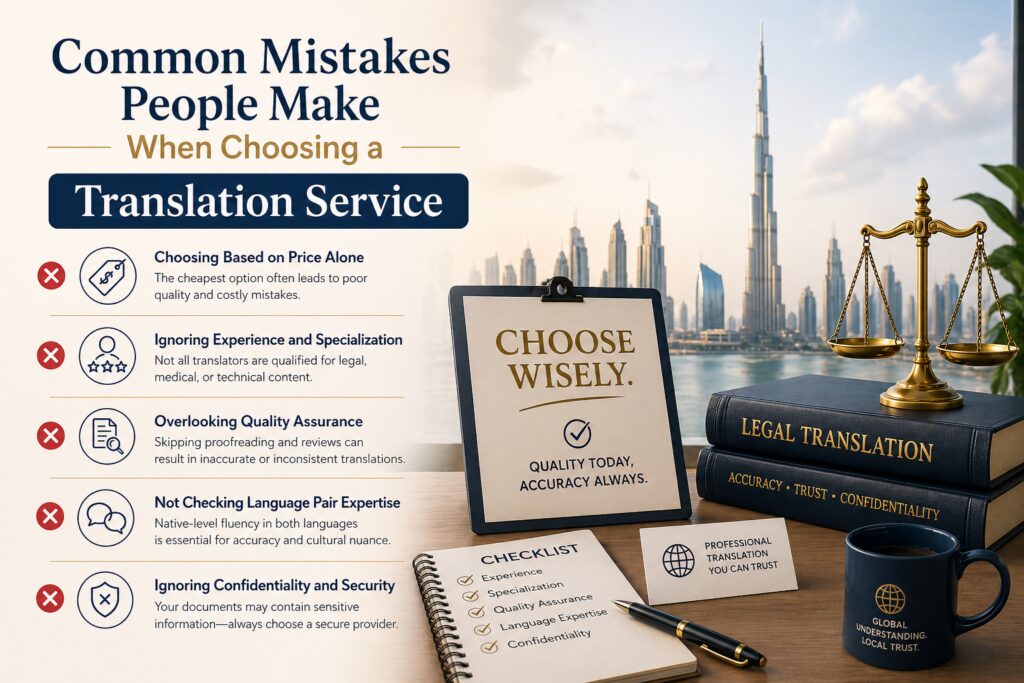
We Assume All Translators Are Equal
Having said this, not every translator is capable of translating legal documents. Translating a recipe is not the same as translating a contract. Find providers who specialise in and have experience with legal translation service work, especially those who are accredited or certified.
Choosing Based on Price Alone
The inexpensive alternative is typically a reflection of inferior quality. The money you save on bargain legal translation can prove to be a very expensive mistake. By using the services of a professional legal translation provider, your translation service will not skip on experienced translators, quality checks, and appropriate certifications.
Ignoring Certification and Credentials
Certified translations are commonly obligatory for official institutions. Service Desk Translation: A certified translation is one that was checked and signed off on by a qualified professional. This is not something that general translators offer, often gone, and they do claim certification that they may not actually have. Inquire specifically about their qualifications and ask whether the translations they provide are certified.
Overlooking Confidentiality Practices
Inquire about the provider’s document processing methods. Where are they stored? Who has access? 4. Once they finish their work, how do you destroy them? Good services will have clear policies.
Types of Documents and Services Offered
An extensive legal translation service with broad document coverage. Knowing what’s out there helps to prepare you for it.
Personal Documents
- Birth, death, and marriage certificates
- Passports and travel documents
- Educational diplomas and transcripts
- Medical records
- Insurance documents
Business and Corporate Documents
- Articles of association and bylaws
- Board resolutions and meeting minutes
- Commercial contracts and agreements
- Employment contracts
- Business licenses
Legal and Compliance Documents
- Court orders and judgments
- Wills and trusts
- Powers of attorney
- Legal correspondence
- Compliance documentation
- Bank statements and account information
- Tax returns and financial statements
- Loan applications
- Investment documents
Many providers also have services such as notarization, apostille (if needed internationally), or rush turnarounds for urgent requests. When you contact a service, inquire as to what types of documents they most frequently deal with—this will typically give you insight into their given expertise.
The Step-by-Step Process: What to Expect
Know the workflow so there is no guessing, and prepare yourself.
Step 1: Initial Consultation
Tell the service what you want to be translated. When asking a question, specify the document type, the languages you are working with, and your deadlines. A professional provider will inquire and ask clarifying questions.
It is during this conversation that they should go over their process, how long it takes, and whether or not your document needs to be certified. This is also where you verify pricing and unique conditions.
Step 2: Document Submission
You’ll give the original document (in person, by email, or secure upload system). Such renowned services ensure the safety of your data and use safe practices during this process.
The length, complexity, and technical requirements of the document will be evaluated by the provider. A straightforward one-page certificate flows quicker than a complex 20-page contract.
Step 3: Translation Work
That document is assigned to a translator or even multiple translators, focusing on legal terms and accuracy. This can take from several hours to several days, depending on its complexity.
Out of these professional services, a quality service will include a review step through which a translator checks the translation for accuracy and consistency.
Step 4: Certification (If Needed)
When a certified translation is required, the final review of the work is made by the translator, along with an affidavit attesting to the fact that the translation has been done faithfully and correctly. What makes the document official in front of official institutions is this certification.
Step 5: Delivery
They then send you a final product, which is usually printed and signed (for certified translations) or digital. Finally, the provider ought to respond to additional questions.
How to Choose the Right Legal Translation Service Provider
This is the decision that counts above all.
Verify Credentials and Experience
Ask about the translator’s qualifications. Do they receive formal training in translation? Are they certified individuals by the UAE Government? For how long have they been doing legal document translation?
A service provider has 10 years of working experience, which adds to his quality, and nobody can compete with a generalist.
Check References and Reviews
Seek reviews from former customers. Check reviews on sites like Google, Facebook, and industry directories. Look out for comments on accuracy, reliability, and also how the provider dealt with addressing queries or reworks.
Do not completely disregard negative reviews; instead, consider the broker’s response. Was the issue handled professionally? You had to force your way (which sometimes they did for issues) to resolve them.
Verify That They Know What You Need
Call, get real on the phone. A well-trained provider will want to know about your case, the date of submission, and where that document will be utilised. Red Flag: Responses are not unique
They should explain why your document needs special treatment and how their service is more reliable for the role.
Ask About Quality Assurance
How do they ensure accuracy? Is there a review process? Are they able to offer testimonials from happy clients? An effective quality assurance process protects you and them.
Understand Pricing and Terms
Get a clear quote in writing. It should specify:
- It is priced on a pay-per-page or flat rate
- Whether certification is included
- The expected completion timeline
- Revision policies
- How rush services are charged
Steer clear of providers who are either very vague about the pricing or offer terms at a much lower rate than should be offered in this market.
Assess Accessibility and Communication
Can you reach them by phone? Are emails returned on time? Whether they are ready for urgent demands or not? Often, if you get immediate feedback on your queries, it indicates a professional service that values its clients’ time.
Building Trust: Quality, Accuracy, and Confidentiality
Before you commit to a service, understand how they protect your interests.
Accuracy Standards
Professional legal translation services maintain rigorous accuracy standards. This means:
- Using native translators with legal expertise
- Implementing a review process before delivery
- Maintaining glossaries of technical terms to ensure consistency
- Understanding the legal context of the documents they translate
A provider should be able to explain their quality assurance process and how they handle complex or ambiguous terms.
Confidentiality and Data Protection
Your documents contain sensitive information. A reliable provider will:
- Use secure storage systems
- Limit access to authorized staff only
- Implement data protection policies aligned with UAE regulations
- Destroy originals or maintain secure archives according to your preference
Ask directly about their confidentiality practices. Professional services should have clear policies that they can share.
Acceptance and Compliance
Official institutions have specific requirements. A qualified legal translation service understands what works in Dubai and can guide you on:
- Whether certification is required for your specific document
- Which official formats are accepted
- Any additional steps (like apostille certification) that might be needed
- Timelines for government processing
They should never make guarantees about acceptance—government decisions are beyond their control—but they can explain what makes a translation likely to be accepted.
Final Thoughts
There is no need to be stressed about discovering a legal translation service in Dubai. If you know what your needs are, what to seek, and what questions to ask, you can pick a provider who will take care of your documents with the precision and finesse they deserve.
The perfect service gives you peace of mind. You are aware that your document will be accurately translated, certified correctly, and acknowledged by the necessary institutions. You have a resource to call with your questions, to trust with sensitive information, and who you can be assured will deliver.
When you are ready to dive in yourself, contact a local provider who can help clarify your specific questions and really walk through the steps involved. This is a task that should be simple—not convoluted—thanks to a professional legal translation service.
FAQs – Legal Translation in Dubai
Have a project in mind, contact us for an instant quote!
Get in touch with our team and receive your free quote today. We’re ready to help you with any legal translation needs in the UAE and beyond.
Get Your Quote